On-device speech to text keeps recordings on the user’s own phone or computer and lets the app work without an account. The price is paid in model size, battery and the weakest hardware you have to support. Those are the trade-offs behind Litt Notes, a voice notes app our team builds as a side project.
What Litt Notes Does
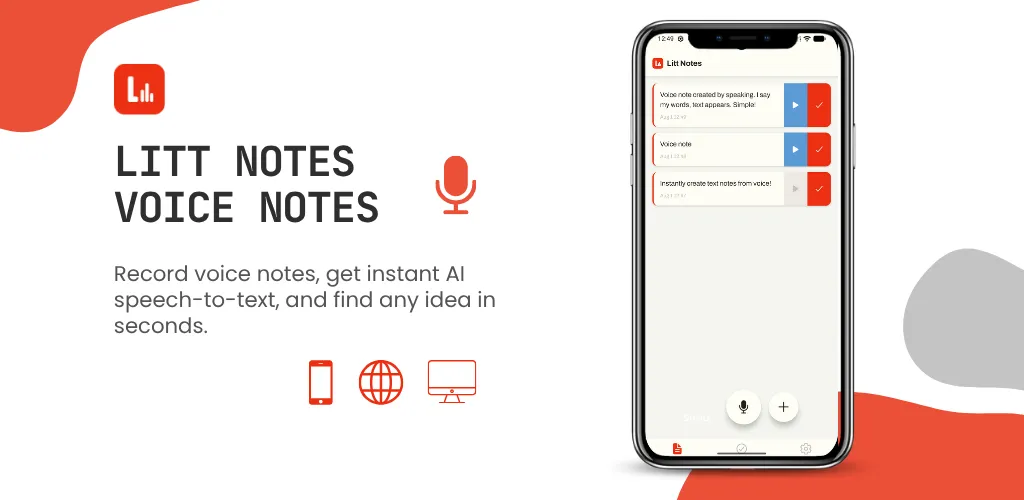
Litt Notes is a voice notes app with instant transcription. You tap record, say what’s on your mind, and the recording becomes searchable text as soon as you stop talking. The original audio stays attached, so nothing is lost if the transcript gets a word wrong. Notes double as to-dos you can swipe to tick off, and they sync between devices.
It’s coming to iOS, Android, web and desktop, with a waitlist open now. Like our other side project, Productive Places, it’s a product where we’re the client for once, which makes the trade-offs more interesting to write about. There’s nobody else to hand them to.
Why Run Speech to Text on the Device Instead of a Server?
Most transcription apps upload your audio to a server and send text back. Litt Notes doesn’t. Transcription runs locally on the phone or computer, so recordings aren’t shipped to a transcription service to be processed, and you can use the app without creating an account at all.
For a voice notes app that’s a big deal, because of what people actually record. Half-formed ideas. Meeting notes with names in them. A reminder about a child’s doctor’s appointment. Promising to handle that carefully on a server is one thing. Not having it on a server to begin with is a much easier promise to keep.
There’s a practical upside too. With no upload step, there’s no queue and nothing waiting on a connection. You stop talking and the text is there.
What On-Device Transcription Costs
None of this comes free, and anyone weighing on-device speech to text for their own product should plan for three costs.
- The model has to live on the device. A server can run the largest model available. An app has to fit a model alongside everything else on a phone that’s already full of photos, and an app people are meant to leave installed can’t be heavy.
- Every second of transcription is the user’s battery. On a server, compute is a line on an invoice. On a phone, it’s the thing the user notices at four in the afternoon.
- You support the weakest device, not the average one. The same app has to work on a new laptop and on a phone that’s five years old. The server approach hides that spread. On-device puts it front and center.
A Game Studio’s Daily Problem
That last cost is familiar to us. Most of what ZeroHint does is ship software to hardware we don’t control. Our WebGL and browser games have to open in a tab on a school computer as well as on a developer’s workstation. A VR build for a standalone headset works to a fixed budget that no amount of optimism will stretch.
The habit carries over directly. You pick the slowest device you’re willing to support, measure there first, and treat the fast machines as a bonus. A model that’s accurate on a flagship phone and unusable on an older one hasn’t solved the problem. It has moved it to the users who can least afford a new phone.
Transcription Is Only Half the Feature
It’s easy to treat speech to text as the product. It isn’t. The point of turning audio into text is that text can be searched. A folder of recordings is a pile nobody goes back through, because finding one sentence means dragging a playhead around and hoping. The Litt Notes blog has a whole piece on why you never listen to your voice notes again, and it’s the clearest explanation of the problem the app is solving.
That changes how you judge transcription quality, too. A transcript doesn’t have to be perfect to be useful. It has to get the words you’ll search for later, the name, the product, the date, and the audio is still attached for anything else.
If you record more ideas than you ever write down, the Litt Notes waitlist is open on its site. And if you’re weighing where AI belongs in your own pipeline, we’ve written about the AI tools we use in game development and where they earn their place.