Most gamification fails because teams add points, badges and a leaderboard to an app that wasn’t engaging to begin with. What keeps people coming back is smaller and less flashy: competitions they can actually win, progress they can see closing, and feedback that shows them getting better.
Why Gamification Fails in Most Mobile Apps
When someone asks us why gamification fails, the honest answer is usually a boring one. The team built a scoreboard and forgot to build the game. We’ve seen the pattern many times. Points, badges and a global leaderboard go in, the update gets announced, and a month later retention is back where it started. Sometimes lower.
Big platforms have already run this experiment for us. LinkedIn dropped its gold Community Top Voice badges in 2024 after people started posting whatever would get them over the threshold, useful or not. Foursquare scrapped mayorships and most of its badges years earlier: users were checking in for trophies, and the check-ins weren’t helping anyone find a good place to eat. Google News quietly retired its reading badges for much the same reason.
Yu-kai Chou, who has written about gamification for over a decade, puts it well. Points, badges and leaderboards are the scoreboard of a game. Nobody walks into an empty stadium, looks up at the scoreboard and suddenly wants to play. Users will chase a badge for a while. Then they get bored and leave.
The S-Curve Problem: Why Stacking Features Backfires
The usual reaction to a gamification feature that flopped is to add more. Daily quests, XP multipliers, levels, social challenges. It rarely helps.
A 2025 study in Frontiers in Psychology found that engagement follows an S-shaped curve as you add game features. A few well-chosen mechanics lift it. Past a certain point each extra one does less, and eventually engagement starts to drop.
Habitica is the example everyone in the field knows. It turns your to-do list into an RPG: tasks become quests, habits change your stats, and a missed deadline costs your character health. In a small academic study of its users, every single participant reported some counterproductive effect. People spent their time managing gear, stats and party health, and the real tasks got pushed aside. On a dashboard it would have looked like great engagement.
The Streak Trap
Streaks are probably the most copied retention mechanic in mobile. They’re also the one most likely to turn on you.
The Decision Lab, a behavioral science consultancy, describes how a streak changes motivation over time. For the first couple of weeks it feels good: I want to do this. Somewhere around day thirty it becomes I can’t break this. Same app, same button. The user is now opening it out of fear of losing something.
Regulators have started paying attention. A 2023 study of about 2,500 Belgian adolescents linked streak features to fear of missing out, weaker self-control and compulsive phone use. In 2024 Nevada’s Attorney General sued Snap, and Snapstreaks were among the features named as designed to keep young users hooked. In the EU, the planned Digital Fairness Act is expected to cover manipulative engagement loops like these.
Duolingo shows streaks can work, as long as the user stays in charge. You set your own daily goal. You can buy a streak freeze. You can take a planned day off without losing everything. A streak that can’t be paused or forgiven turns into a chore, and people quit chores.
What Actually Retains Users?
Look at the products that keep people for years and three patterns show up again and again.
1. Competitions People Can Win (Strava)
A global leaderboard is mostly a list of people you’ll never beat. If you’re ranked 450,000th, it isn’t motivating you. It’s quietly telling you to give up.
Strava splits competition into segments: the hill on your usual route, the flat stretch outside your office. You’re up against people nearby, often in your own age group, so a top-ten spot is realistic. A 2022 study in ScienceDirect found that believing you can win was the strongest predictor of competitive motivation. Add kudos, a one-tap “nice work” from friends, and you end up with an app people open for about two minutes for every hour they spend exercising.
2. Closing the Loop (Apple Watch)
Apple’s activity rings don’t rely on badges, levels or points, and they still change behavior. Apple has reported a 49.5% positive behavior change across a study cohort of around 160,000 people.
The rings work on a simple idea from Gestalt psychology: an unfinished shape bothers us. If your Move ring is sitting at 85% at 7 PM, there’s a fair chance you’ll go for a short walk. Nothing bad happens if you don’t. You just want to see it close.
3. Feedback That Shows Real Progress (Peloton and Chess.com)
A 2024 meta-analysis published by Springer Nature found that typical gamification features help people feel autonomous and connected to others. They do very little for their sense of competence. That matters, because noticing that you’re getting better at something is one of the strongest drivers of long-term motivation.
The products that get this right measure something real. Peloton shows live power output, and its 100-ride milestone means you actually rode 100 times. Members who use its performance tracking work out about 15% more often. Chess.com puts your rating front and center. Garmin shows heart-rate variability and training readiness. Turning up isn’t what gets rewarded here. Getting better is.
How We Apply This in Our Own Projects
At ZeroHint we build serious games and interactive training software, usually for clients where retention decides whether the project worked at all. A reward loop that looks good in a pitch deck doesn’t last long in front of real users.
With Hacettepe University’s Faculty of Physical Therapy and Rehabilitation, under a TÜBİTAK ARDEB 1001 research project, we’re building VR and 2D rehabilitation games for proprioception. Cartoon badges on a physical therapy exercise would make patients take it less seriously. So the games give real-time feedback on the movement itself and a clear target for each session. Patients can see whether their control is improving, and that’s what they care about.
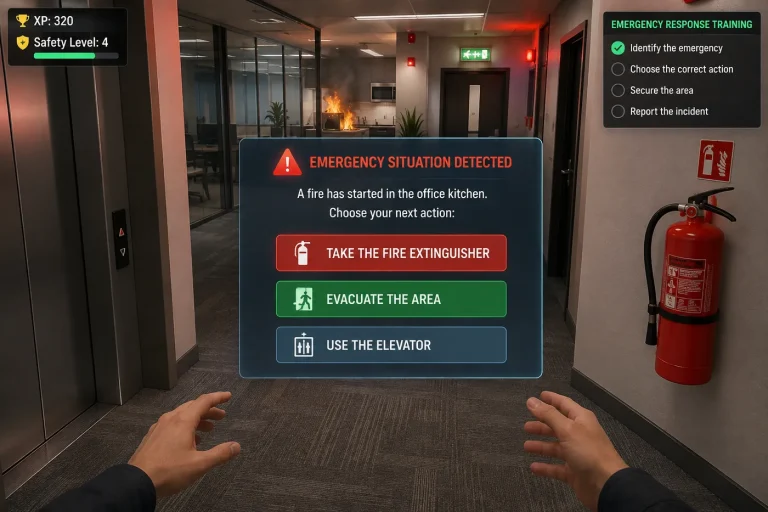
For DijiVat, the digital citizenship game we made with Türkiye’s Ministry of National Education and the Council of Europe, the audience is school students on EBA, where more than 5,000,000 of them can access it. We left out the score ticker. Students make choices in realistic online situations and see where those choices lead. The scenarios carry the game, so it doesn’t need a points system on top.
What to Check Before You Add Another Game Mechanic
Before your team starts building the next gamification feature, ask three questions:
- Can most users actually win? If not, swap the global leaderboard for small groups and personal milestones where effort shows up as progress.
- Does the reward mean they got better, or just that they showed up? Tie progress to skill, finished goals or something genuinely useful. Login counts don’t count.
- Can users pause or recover a streak? Add freezes, adjustable goals and rest days before loss aversion turns into churn.
If you’re planning a gamified product, or trying to fix retention in one that’s already live, our gamification services page explains how we approach it. For full builds there’s our game development services page, and for training and learning projects, educational and serious games.